Mobile App:
AndroidiOSFREE

advertisement

German Naturalization Test Berlin 2026 - Free PDF Downloads

Prepare optimally for the German naturalization test in Berlin with our free PDF practice tests.

Available practice tests for Berlin:

10 special questions for federal state Berlin

In the naturalization test, 3 of these 10 questions will be asked.

All Berlin-specific questions:

  1. Question 1: Welches Wappen gehört zum Bundesland Berlin?

    Image for question 1

    Answer options:

    1. A) Bild 1
    2. B) Bild 2
    3. C) Bild 3
    4. D) Bild 4 ✓ (Correct Answer)

    Explanation:

    The correct answer is D, because Germany's Basic Law guarantees freedom of opinion. This fundamental right ensures that citizens can express their views, even critical ones, about the government without fear of reprisal. Option A, freedom of religion, is a protected right but does not directly relate to the ability to criticize the government. Option B, paying taxes, is a civic duty but not the legal basis for free speech. Option C, the right to vote, is an important democratic right, but freedom of opinion is the specific principle that allows for open criticism of the government. The ability to speak openly against the government stems directly from the principle of freedom of expression enshrined in the constitution.

    Study Tip:

    Freedom of opinion allows citizens to speak openly against the government.

    Federal State: Berlin

  2. Question 2: Welches ist ein Bezirk von Berlin?

    Answer options:

    1. A) Altona
    2. B) Prignitz
    3. C) Pankow ✓ (Correct Answer)
    4. D) Mecklenburgische Seenplatte

    Explanation:

    The correct answer is B, Religionsunterricht. German Basic Law, specifically Article 7, guarantees freedom of religion and conscience, which extends to the right of parents to decide on their child's religious education. This principle allows parents to opt their children in or out of religious instruction. Option A, Geschichtsunterricht, is a mandatory part of the curriculum for all students, as understanding history is fundamental to civic education. Similarly, option C, Politikunterricht, is essential for developing informed citizens and is therefore compulsory. Option D, Sprachunterricht, is also a core component of schooling, ensuring basic communication and literacy skills. Therefore, only participation in religious instruction, as outlined in Article 7 of the Basic Law, is subject to parental decision-making up to the age of 14.

    Study Tip:

    Parents decide on religious education for children under 14 due to religious freedom.

    Federal State: Berlin

  3. Question 3: Für wie viele Jahre wird das Landesparlament in Berlin gewählt?

    Answer options:

    1. A) 3
    2. B) 4
    3. C) 5 ✓ (Correct Answer)
    4. D) 6

    Explanation:

    The correct answer is A because the principle of the rule of law (Rechtsstaatsprinzip) dictates that both citizens and the state are bound by the law. This is a fundamental aspect of German constitutional law, ensuring legal certainty and the protection of individual rights against arbitrary state action. Option B is incorrect because it directly contradicts the definition of a Rechtsstaat; the state's adherence to law is precisely what distinguishes it. Option C is also incorrect as the rule of law applies universally within the territory of Germany, not just to German citizens. Furthermore, option D misrepresents the legislative process; while courts interpret laws, they do not create them in a democratic system. The core idea is that no one is above the law, including those who govern.

    Study Tip:

    The state must follow the law, just like everyone else.

    Federal State: Berlin

  4. Question 4: Ab welchem Alter darf man in Berlin bei Kommunalwahlen (Wahl der Bezirksverordnetenversammlung) wählen?

    Answer options:

    1. A) 14
    2. B) 16 ✓ (Correct Answer)
    3. C) 18
    4. D) 20

    Explanation:

    The correct answer is Meinungsfreiheit (freedom of speech) because it is explicitly listed as a fundamental right in Article 5 of the German Basic Law. This principle is foundational to a democratic society, ensuring individuals can express their thoughts and opinions without undue government interference. The option Waffenbesitz (possession of weapons) is not a guaranteed fundamental right, though it may be regulated by law. Faustrecht (might makes right) and Selbstjustiz (vigilantism) are explicitly contrary to the rule of law and are not recognized rights in Germany; instead, they are prohibited actions that undermine the legal system. The Basic Law protects fundamental freedoms and rights to ensure a just and democratic society, and freedom of speech is a cornerstone of this protection.

    Study Tip:

    Meinungsfreiheit is a fundamental right in Germany, protected by Article 5 of the Basic Law.

    Federal State: Berlin

  5. Question 5: Welche Farben hat die Landesflagge von Berlin?

    Answer options:

    1. A) blau-weiß-rot
    2. B) weiß-rot ✓ (Correct Answer)
    3. C) grün-weiß-rot
    4. D) schwarz-gold

    Explanation:

    Option C is correct because freedom of election, as guaranteed by Article 38 of the Basic Law, means that voters can cast their ballot without coercion or undue influence, and without fear of negative consequences for their choice. This principle ensures the integrity of the democratic process. Option A is incorrect because accepting money to vote for a specific candidate directly contradicts the principle of free elections and would be considered bribery, undermining voter autonomy. Option B is incorrect; a prior prison sentence does not automatically disqualify someone from voting in Germany, as long as other eligibility requirements are met. Option D is incorrect because voting in Germany is a right, not a mandatory obligation; citizens are not compelled to participate in elections. The core idea of free elections is that your vote is your own, uninfluenced and uncoerced.

    Study Tip:

    The core idea of free elections is that your vote is your own, uninfluenced and uncoerced.

    Federal State: Berlin

  6. Question 6: Wo können Sie sich in Berlin über politische Themen informieren?

    Answer options:

    1. A) beim Ordnungsamt der Gemeinde
    2. B) bei den Kirchen
    3. C) bei der Verbraucherzentrale
    4. D) bei der Landeszentrale für politische Bildung ✓ (Correct Answer)

    Explanation:

    The correct answer is "Grundgesetz" because it is the name of the constitution of the Federal Republic of Germany, established by Article 146 of the Basic Law itself. This document outlines the fundamental rights and the political structure of the nation. The option "Volksgesetz" is incorrect as it translates to "people's law" and is not the formal designation for the German constitution. "Bundesgesetz" means "federal law" and refers to laws passed by the federal government, but not the foundational constitution. "Deutsches Gesetz" is a general term for "German law" and lacks the specific meaning of the constitution. The Grundgesetz serves as the supreme law of Germany, guaranteeing fundamental rights and freedoms and establishing the framework for the federal government. It is the cornerstone of the German legal and political system.

    Study Tip:

    The 'Grund' in Grundgesetz means 'basic' or 'foundation', highlighting its role as the foundational law of Germany.

    Federal State: Berlin

  7. Question 7: Welches Bundesland ist ein Stadtstaat?

    Answer options:

    1. A) Berlin ✓ (Correct Answer)
    2. B) Saarland
    3. C) Brandenburg
    4. D) Hessen

    Explanation:

    Option A, the right to freedom of belief and conscience, is a fundamental human right explicitly protected by Article 4 of the German Basic Law (Grundgesetz). This constitutional guarantee ensures individuals can hold and express any religious or philosophical beliefs without state interference. Option B, the right to entertainment, is not a constitutionally guaranteed fundamental right. While leisure activities are important for well-being, they do not carry the same legal protection as core freedoms. Option C, the right to work, is also not an absolute fundamental right in the German constitution, though the state is obligated to promote employment. Similarly, Option D, the right to housing, is not a directly enforceable fundamental right under the Basic Law, though it is considered a social goal.

    Study Tip:

    Freedom of belief and conscience is a core human right enshrined in Article 4 of the Basic Law.

    Federal State: Berlin

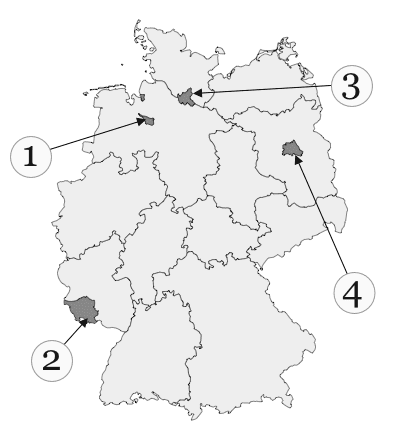
  8. Question 8: Welches Bundesland ist Berlin?

    Image for question 8

    Answer options:

    1. A) 1
    2. B) 2
    3. C) 3
    4. D) 4 ✓ (Correct Answer)

    Explanation:

    Option B, "Alle sollen gleich viel Geld haben," is not found in the German Basic Law. The Grundgesetz guarantees fundamental rights and freedoms, but it does not mandate an equal distribution of wealth, which is an economic policy matter. Option A, "Die Würde des Menschen ist unantastbar," is the very first article of the Basic Law and a cornerstone of German constitutional law. Option C, "Jeder Mensch darf seine Meinung sagen," is protected under freedom of expression, a fundamental right. Option D, "Alle sind vor dem Gesetz gleich," is also a key principle enshrined in the Basic Law, ensuring legal equality. Therefore, only the idea of everyone having the same amount of money is absent from the Grundgesetz, as it focuses on rights and freedoms rather than specific economic outcomes.

    Study Tip:

    The Grundgesetz protects fundamental rights, not economic equality.

    Federal State: Berlin

  9. Question 9: Wie nennt man die Regierungschefin/den Regierungschef des Stadtstaates Berlin?

    Answer options:

    1. A) Ministerpräsidentin/Ministerpräsident
    2. B) Oberbürgermeisterin/Oberbürgermeister
    3. C) Präsidentin/Präsident des Senates
    4. D) Regierende Bürgermeisterin/Regierender Bürgermeister ✓ (Correct Answer)

    Explanation:

    The correct answer is C, Asyl, the right to asylum. This right is explicitly guaranteed to persecuted persons in Article 16a of the German Basic Law. While other fundamental rights are generally applicable, the specific legal framework for asylum protection is unique to non-citizens facing persecution. Option A, Schutz der Familie, the protection of family, is a fundamental right that applies to all individuals, regardless of their nationality, as recognized in Article 6 of the Basic Law. Similarly, Option B, Menschenwürde, human dignity, is an inviolable right for every person in Germany, as stated in Article 1 of the Basic Law, and thus not exclusive to foreigners. Option D, Meinungsfreiheit, freedom of expression, is also a general fundamental right for everyone residing in Germany under Article 5 of the Basic Law.

    Study Tip:

    Asylum is the only right specifically granted to non-citizens in the Basic Law.

    Federal State: Berlin

  10. Question 10: Welche Senatorin/welchen Senator hat Berlin nicht?

    Answer options:

    1. A) Finanzsenatorin/Finanzsenator
    2. B) Innensenatorin/Innensenator
    3. C) Senatorin/Senator für Außenbeziehungen ✓ (Correct Answer)
    4. D) Justizsenatorin/Justizsenator

    Explanation:

    The correct answer is "die Geldstrafe" (a fine). Fines are a form of punishment that is compatible with the German Basic Law (Grundgesetz). Article 2 of the Basic Law guarantees the right to physical integrity and prohibits torture and cruel, inhuman, or degrading treatment or punishment, which would encompass the other options. "Die Prügelstrafe" (corporal punishment) and "die Folter" (torture) are explicitly prohibited by Article 2 of the Basic Law, as they violate fundamental human dignity and the right to physical integrity. "Die Todesstrafe" (the death penalty) is also abolished in Germany, as stipulated in Article 102 of the Basic Law. Therefore, only the imposition of a fine is a legally permissible consequence within the framework of the German legal system and the Basic Law.

    Study Tip:

    Think of fines as a financial penalty, not a physical one, aligning with the Grundgesetz's protection of the body.

    Federal State: Berlin

Leben in Deutschland - Einbürgerungstest Berlin

10 Bundesland-Fragen - Diese Fragen sind spezifisch für Ihr Bundesland und werden in Ihrem Einbürgerungstest erscheinen.

Q1Berlin

Welches Wappen gehört zum Bundesland Berlin?

Q2Berlin

Welches ist ein Bezirk von Berlin?

Q3Berlin

Für wie viele Jahre wird das Landesparlament in Berlin gewählt?

Q4Berlin

Ab welchem Alter darf man in Berlin bei Kommunalwahlen (Wahl der Bezirksverordnetenversammlung) wählen?

Q5Berlin

Welche Farben hat die Landesflagge von Berlin?

Q6Berlin

Wo können Sie sich in Berlin über politische Themen informieren?

Q7Berlin

Welches Bundesland ist ein Stadtstaat?

Q8Berlin

Welches Bundesland ist Berlin?

Fragenbezogen
Q9Berlin

Wie nennt man die Regierungschefin/den Regierungschef des Stadtstaates Berlin?

Q10Berlin

Welche Senatorin/welchen Senator hat Berlin nicht?

Bereit, Ihr Wissen zu testen?

Starten Sie den Test-Simulator, um unter realen Prüfungsbedingungen mit bundeslandspezifischen Fragen zu üben

Kostenlose Einbürgerungstest PDFs für Berlin

Bereiten Sie sich optimal auf den Einbürgerungstest vor mit unseren kostenlosen Übungstests speziell für Berlin. Alle PDFs enthalten Lösungsschlüssel und detaillierte Erklärungen.

Fortgeschritten

Complete practice test with 33 questions specifically for Berlin - 1

Complete practice test with 33 questions specifically for Berlin

33 Fragen
1.8 MB
PDF Herunterladen
Experte

Complete practice test with 33 questions specifically for Berlin - 2

Complete practice test with 33 questions specifically for Berlin

33 Fragen
1.9 MB
PDF Herunterladen

Warum unsere Berlin Übungstests verwenden?

Bundesland-spezifisch

Alle 10 speziellen Fragen für Berlin mit detaillierten Erklärungen

Vollständige Tests

33 Fragen pro Test - genau wie in der echten Prüfung

Kostenlos

Alle PDFs sind komplett kostenlos und ohne Anmeldung verfügbar

Weiterführende Ressourcen

Fortschritt
Gesamtfortschritt0/300
0 Richtig0 Falsch300 Unbeantwortet